
Momentum CFO
  • About
    • About Momentum CFO
    • Speaking & Media
  • Services
    • Momentum CFO Financial Health Check™
    • Fractional CFO Services
    • FP&A Consulting Services
  • Clients
    • Online Booking
    • New Client Onboarding
  • Resources
    • Blog
    • FAQ
    • Case Studies
  • Contact
  • Schedule A Free Consultation
  • Click to open the search input field Click to open the search input field Search
  • Menu Menu
Finance Education, Financial Management, FP&A, News

What Is FP&A? A Guide for Growing Businesses

What Is FP&A?

Many business leaders review financial reports regularly but find it harder to interpret what those numbers mean for the future. Last quarter’s results are clear. What should happen next is less so. This is the gap that financial planning and analysis, or FP&A, is designed to close.

FP&A is a corporate finance function responsible for helping business leaders make better decisions. Accounting records performance. FP&A predicts it. Through planning, forecasting, performance management, and analysis, it gives leadership a forward-looking view of business performance and the financial clarity to act on it.

For growing businesses, that forward view becomes increasingly critical. Growth creates complexity: more customers, more people, more departments, and more financial variables to manage. FP&A provides the visibility to understand what is driving results, where the business is on track or off, and where resources should go next.

Most businesses first encounter FP&A through familiar deliverables: the annual budget, monthly or quarterly forecast updates, variance analysis, KPI reporting, board and investor reporting, and financial models used to evaluate hiring, pricing, investment, or expansion decisions. These are the visible outputs of a function whose real purpose is enabling informed decisions about resources, risk, and growth.

What FP&A Actually Does

FP&A encompasses four core activities: planning, forecasting, performance management, and analysis. Each is distinct but complementary.
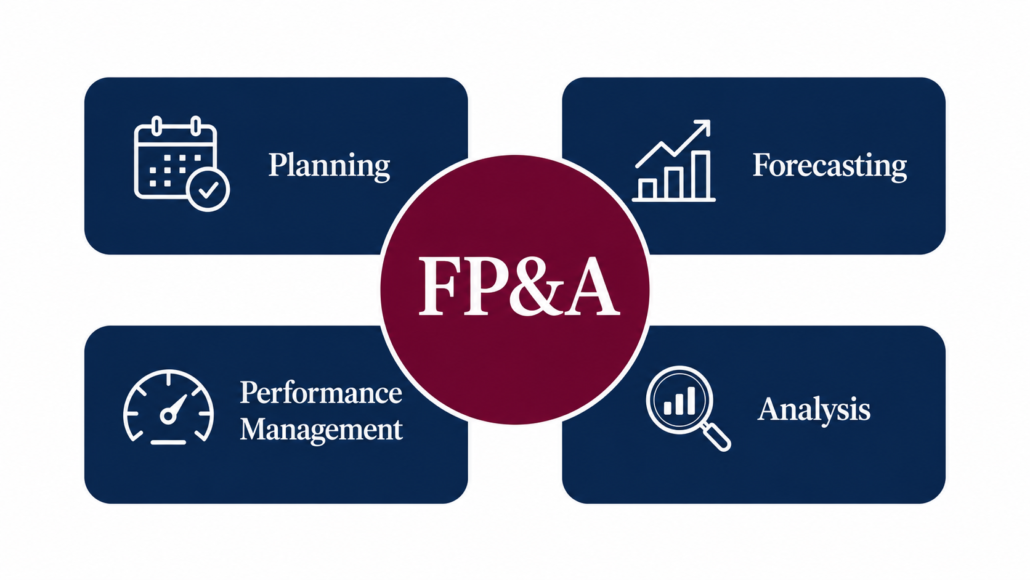
Diagram showing the four core activities of FP&A: planning, forecasting, performance management, and analysis.
FP&A integrates four core activities: planning, forecasting, performance management, and analysis.

Planning

Planning is where FP&A begins. Its most essential output is the budget: a financial roadmap, typically built at the start of each fiscal year, that allocates resources to their highest and best use in pursuit of company goals.

A well-constructed budget does more than set revenue targets and expense limits. It reflects deliberate choices about where the business will invest, where it will pull back, and what tradeoffs it is willing to make to achieve its strategic priorities. A business may decide to invest more heavily in sales headcount, technology infrastructure, or new market entry. Each of those choices carries financial consequences. FP&A helps leadership understand those consequences before resources are committed.

For a deeper look at how budgeting works in practice, see Three Types of Business Budgets.

Forecasting

Forecasting is the function that keeps the business grounded in reality as the year unfolds. A budget is set once and does not change. Business conditions do.

A forecast incorporates actual results as they become available and refines the assumptions underlying the original plan, producing an updated picture of where the business is likely to land. FP&A teams typically update forecasts monthly or quarterly. At a minimum, a forecast covers the remainder of the current fiscal year. In many businesses, the forecast extends two to three years into the future.

That forward horizon is what makes forecasting a genuine management tool rather than a restatement of the plan. It helps leadership answer questions such as:

  • Are we still on track to hit our revenue and profitability goals?
  • Is cash flow tightening, and if so, what is driving it?
  • Are gross margins improving or deteriorating, and why?
  • Do current trends support the original plan, or does the business need to adjust course?

Without a regular forecast, leadership is often making decisions based on a plan that no longer reflects the business.

Performance Management

Performance management is how FP&A monitors progress against plan. It includes reporting, variance analysis, KPI tracking, and recurring financial reviews that help leadership understand whether the business is on track and why results are coming in the way they are.

Reporting is an output of performance management, not the goal. A good FP&A process does not simply show that revenue was below budget or expenses were above plan. It explains what happened, why it matters, whether it is likely to continue, and what leadership should consider doing next. That is the difference between seeing a number and understanding the business.

Analysis

Analysis is the thread that runs through planning, forecasting, and performance management alike. It answers the questions that raw data cannot:

  • Why did gross margin decrease last quarter?
  • Which product lines, services, customers, or locations are the most and least profitable?
  • If headcount grows by 20 percent next year, what happens to the company’s cost structure?
  • What happens to cash flow if sales slow, collections are delayed, or costs rise?

Analysis surfaces the patterns, relationships, and implications in financial data that inform decisions about hiring, pricing, investment, and growth. It is what transforms financial information into something leadership can act on.

Together, these four activities define what FP&A does. A business that plans without forecasting operates on assumptions that go unchallenged. A business that reports without analyzing knows what happened but not what to do about it.

FP&A vs. Accounting: Why the Difference Matters

Every growing business starts with accounting, and for good reason. Accurate books, tax compliance, and financial reporting are foundational requirements. Without them, nothing else in finance works.

But accounting and FP&A serve different purposes. Accounting answers the question: what happened? FP&A answers the questions that come next: why did it happen, what does it mean, and what should we do next?

AspectAccountingFP&A
OrientationPrimarily backward-lookingPrimarily forward-looking
Core functionRecords financial transactionsInterprets financial results
Primary outputsFinancial statementsBudgets, forecasts, analysis, decision support
FocusAccuracy, compliance, and historical reportingPlanning, performance, risk, and future outcomes
Key questionsWhat happened?Why did it happen, what does it mean, and what should we do next?

Accounting records what has occurred: revenue recognized, expenses incurred, assets owned, liabilities owed. Its standards are defined by accuracy, completeness, and compliance. FP&A takes that historical record and asks what it means for the future, helping leaders understand what choices are available and how decisions may affect profitability, cash flow, growth, and enterprise value.

The two functions are complementary, not competing. FP&A depends on accurate accounting data to do its work well. But knowing what happened is not the same as knowing what to do next. As a business grows and financial complexity increases, leadership needs both. For a closer look at how these two functions relate, see Accounting vs. Finance.

Signs Your Business Needs FP&A Now

For many businesses, FP&A is not a function they set out to build. It becomes necessary as the organization outgrows what accounting alone can provide. The challenge is recognizing when that threshold has been crossed.

These are common signs that your business may need FP&A now.

Financial reports are available, but the story behind them is not clear.

You can see the numbers but struggle to explain what is driving performance. Revenue may be up but profitability may be flat. Expenses may be over budget, but it is not clear whether the issue is timing, volume, pricing, hiring, productivity, or something more structural. FP&A translates financial results into a management narrative leadership can use.

There is no regular forecasting process.

Actual results accumulate, but they are not used to update assumptions or refresh the financial outlook. Leadership is making forward-looking decisions based on a plan that no longer reflects current conditions. A regular forecast keeps the business grounded in reality and allows for course correction before problems become urgent.

Hiring, pricing, or investment decisions lack a financial framework.

Consequential decisions are being made on instinct or incomplete information rather than forward-looking analysis. Should the business hire ahead of growth or wait? Can it afford a new system, location, product line, or sales initiative? FP&A provides the analytical framework to evaluate options and quantify tradeoffs before resources are committed.

Profitability is unclear below the company level.

Revenue is coming in, but there is no clear picture of which products, services, customers, or lines of business are most and least profitable, or what can be done to improve the mix. Without that visibility, decisions about pricing, cost structure, and where to invest for growth are difficult to make with confidence.

Cash flow visibility is limited.

For businesses that have raised capital, including portfolio companies operating under PE or institutional ownership, understanding runway and cash burn rate is critical. Without a reliable forecast, these questions are difficult to answer with confidence, and by the time cash pressure builds, the window to act has often narrowed. FP&A gives leadership earlier visibility into potential constraints and the options available to address them.

The business is approaching a significant inflection point.

A capital raise, acquisition, major expansion, or potential exit requires a higher level of financial rigor. Standard accounting reports are not enough. These moments require forward-looking analysis, credible forecasts, scenario planning, and clear explanations of the financial drivers of the business.

Any one of these signs is worth taking seriously. Together, they indicate that the business has reached a stage where FP&A is no longer a nice-to-have. It is what makes the difference between reacting to financial outcomes and getting ahead of them.

How FP&A Evolves with Your Business
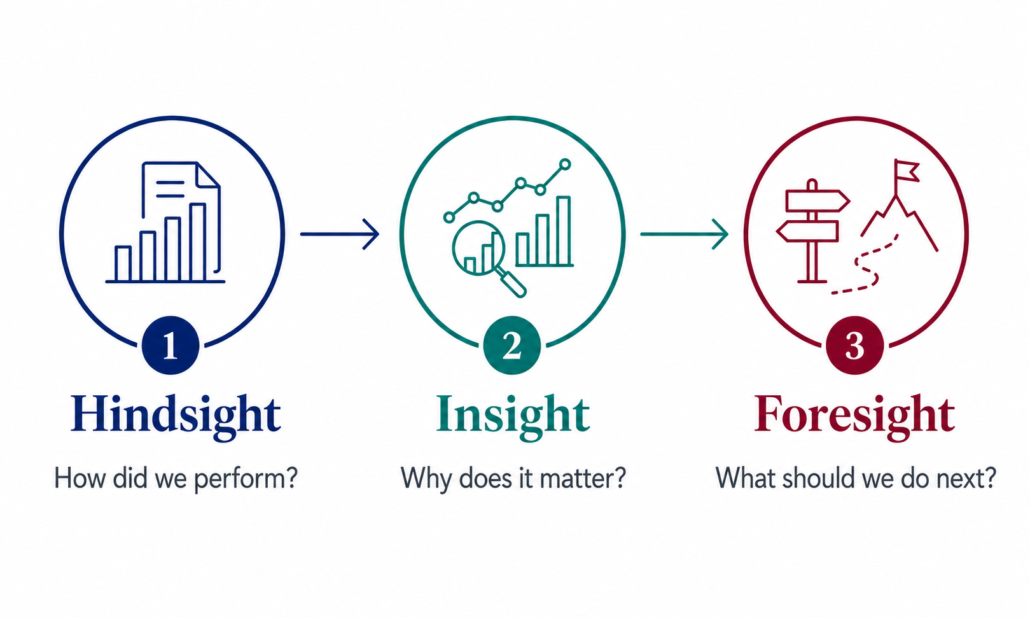
Diagram showing the three stage evolution of FP&A capability: Hindsight, Insight, and Foresight, with the questions each stage answers.

FP&A does not look the same at every stage of growth. Building the capability does not require starting with a full team. What matters is that the function exists in a form proportionate to the complexity and ambitions of the business, and that it continues to develop as those demands increase.

A useful way to think about FP&A maturity is the progression from hindsight to insight to foresight.

Stage 1: Hindsight

At the earliest stage, many businesses have no standalone FP&A function. Accounting staff handle some budgeting and reporting responsibilities alongside their core work. The finance function has not yet developed true FP&A capability: the budget exists as a fixed reference point, reporting is largely descriptive, and forward-looking analysis is limited. The business can see what happened but has limited ability to explain what it means or anticipate what comes next.

Stage 2: Insight

As complexity grows, the business needs a more deliberate FP&A capability. This is often the stage where a fractional FP&A engagement delivers significant value: bringing enterprise-level analytical capability to bear without the cost or overhead of a full-time hire. Forecasting becomes more regular and more accurate and rigorous. Reporting becomes more purposeful, delivering the right information to the right people rather than distributing a standard package. FP&A begins to shift from hindsight to insight, explaining not just what happened but why, and what it means for the decisions ahead.

For businesses ready to think about building a more formal function, see How to Build an FP&A Team.

Stage 3: Foresight

At the most developed stage, FP&A operates as a genuine strategic partner to leadership. Planning and forecasting are integrated across the business, scenario analysis is built into the regular management cadence, and finance is a trusted source of foresight for the CEO, board, and investors. This is where FP&A helps leadership evaluate not just what is likely to happen, but what could happen under different assumptions, and what decisions should be made now as a result.

For businesses that have raised institutional capital or are operating under PE ownership, FP&A expectations are typically more demanding from the outset. Investors and sponsors require regular, detailed reporting, rigorous forecast accuracy, and the analytical infrastructure to support portfolio-level decision-making.

Building that capability well requires clarity about what FP&A needs to deliver and how it fits within the broader finance organization.

Common Questions About FP&A

What does FP&A stand for?

FP&A stands for financial planning and analysis. It is the corporate finance function responsible for budgeting, forecasting, performance management, financial analysis, and decision support. In practical terms, FP&A helps leadership understand where the business is headed, what choices are available, and what decisions may be needed to improve performance, manage risk, and support growth.

How is FP&A different from accounting?

Accounting records what has happened: revenue, expenses, and the financial position of the business at a point in time. FP&A takes that historical record and asks what it means for the future. Accounting answers “what happened?” FP&A answers “why did it happen, what does it mean, and what should we do next?” The two functions are complementary. Businesses build accounting capability first and add FP&A as complexity and growth demands increase.

Does my business need a dedicated FP&A hire?

A dedicated FP&A hire is not always necessary right away. Many businesses benefit significantly from FP&A capability before they are ready to justify a full-time role. An outsourced FP&A engagement can provide enterprise-level planning, forecasting, and analytical support on a part-time or project basis, scaled to the needs and stage of the business. As the function matures and demand increases, building toward a dedicated role or team becomes a natural next step.

When is the right time to invest in FP&A?

The right time is earlier than most businesses act on it. The common trigger is a problem that has already become visible: a cash flow crunch, a missed forecast, a capital raise that exposed gaps in the financial infrastructure, or a board meeting where no one can clearly explain what is driving performance. The businesses that get the most value from FP&A invest in it before those moments arrive, using it to anticipate outcomes and identify risks before the business is forced into a reactive posture. If your business is growing, managing investor expectations, making significant resource decisions, or approaching a major inflection point, building FP&A capability before the need becomes urgent is the right call.

What is the difference between FP&A and a CFO?

A CFO is a senior leadership role with broad responsibility for the financial health of the business, including accounting, treasury, capital structure, investor relations, and strategic financial leadership. FP&A is a function within the Office of the CFO focused specifically on planning, forecasting, performance management, analysis, and decision support. In smaller businesses, a fractional CFO may perform both roles. As a business scales, the two often become distinct, with FP&A serving as the analytical engine that supports informed decision-making across the leadership team.

The Bottom Line

FP&A is the corporate finance function that transforms financial data into forward-looking insight. Through planning, forecasting, performance management, and analysis, it gives leadership the clarity to allocate resources, manage risk, and pursue growth with confidence.

Every business starts with accounting, and accounting remains essential. But as a business grows, knowing what happened is no longer sufficient. Leadership needs to understand why results are coming in the way they are, anticipate what comes next, and make informed decisions before the window to act has closed. Better visibility, stronger forecasts, more disciplined resource allocation, clearer tradeoffs in decision-making, and more confident board and investor communication: that is what FP&A makes possible.

Whether your business is navigating its first serious growth phase, preparing for a capital raise, managing investor expectations, or building toward an exit, FP&A is what separates reactive financial management from deliberate, forward-looking strategy.

If your business has outgrown basic financial reporting and needs better forecasting, visibility, or decision support, schedule a free introductory consultation with Momentum CFO.

June 12, 2026
https://momentumcfo.com/wp-content/uploads/2026/06/what-is-fpa.png 1254 1254 Momentum CFO https://momentumcfo.com/wp-content/uploads/2022/01/momentum-cfo_brand-identity_Final_RGB_Signature_Full-Color-1030x254.png Momentum CFO2026-06-12 14:47:342026-06-15 09:52:55What Is FP&A? A Guide for Growing Businesses
Finance Education, Financial Management, News

How to Read a Balance Sheet

Introduction

If you’ve ever wondered how to read a balance sheet without a strong finance background, this guide is for you. Many executives and business owners focus heavily on the income statement (P&L) while overlooking the balance sheet, even though it provides an important view of your company’s financial position: what the business owns, what it owes, and what belongs to owners.

At Momentum CFO, we work with business leaders to transform financial statements into practical insights. This guide explains how you can use the balance sheet to assess risk, identify growth opportunities, and build a stronger foundation for the future.

What Is a Balance Sheet?

The balance sheet is one of the three core financial statements, along with the income statement and the cash flow statement.

Financial StatementTime FrameWhat it Shows
Balance SheetPoint in time (e.g., May 31)Assets, liabilities, equity (financial position)
Income Statement (P&L)Period (month/quarter/year)Revenue, expenses, profit or loss (performance)
Cash Flow StatementPeriod (month/quarter/year)Cash inflows/outflows from operating, investing, and financing activities

Unlike those, which measure performance or cash flows over a period of time, the balance sheet is a snapshot of a single point in time.

The balance sheet has three main sections:

  • Assets – what your company owns and uses to operate.
  • Liabilities – what your company owes to creditors.
  • Equity – what remains for owners after liabilities are paid.

Together, these three sections provide a full picture of your company’s financial health.

The Balance Sheet Equation

At the heart of every balance sheet is a simple equation:

Assets = Liabilities + Equity

Or restated:

Equity = Assets – Liabilities

This balance sheet must always balance. Every dollar of assets is financed either by debt (liabilities) or by owners’ investment (equity).

The Three Sections of the Balance Sheet

The balance sheet tells a story of your business in three parts:

  1. Assets (What You Own): These are the resources your business uses to create value, including cash in the bank, receivables from customers, inventory, and investments in property or equipment. Strong assets give your business resilience and flexibility.
  2. Liabilities (What You Owe): These are your financial obligations to lenders, suppliers, employees, and tax authorities. Liabilities can fuel growth, but too much reliance on debt can create risk.
  3. Equity (What Belongs to Owners): This is the value left over for owners after paying off liabilities. Equity reflects how much of the business is truly yours.

When you understand how these sections fit together, you can see whether your company is building value, straining under debt, or balancing the two.

Assets: What You Own

Assets are divided into two categories: current assets (convertible to cash within 12 months) and non-current/long-term assets (held for longer).

Current Assets include:

  • Cash & Cash Equivalents – Bank balances or short-term investments.
  • Accounts Receivable (A/R) – Customer invoices not yet collected.
  • Inventory – Raw materials, work-in-progress, finished goods.
  • Prepaid Expenses – Payments made in advance (insurance, rent).
  • Other Current Assets – Deposits, employee advances.

Non-Current Assets include:

  • Property, Plant & Equipment (PP&E) – Buildings, machinery, vehicles.
  • Intangible Assets – Patents, software, trademarks.
  • Goodwill – Value recorded when a company buys another business for more than the fair market value of its assets. It reflects things like brand reputation, loyal customers, or strong relationships that add value beyond physical assets.

Why it matters: Monitoring assets shows whether growth is supported by liquid resources like cash or tied up in less flexible forms such as inventory and equipment. This perspective helps you manage liquidity, prioritize investments, and ensure your resources align with your strategy.

Liabilities: What You Owe

Liabilities are also divided into current and non-current categories.

Current Liabilities include:

  • Accounts Payable (A/P) – Vendor bills not yet paid.
  • Accrued Expenses – Wages, taxes, utilities incurred but not paid.
  • Short-Term Debt – Lines of credit, loan installments due within a year.
  • Deferred Revenue – Payments collected before delivering products/services.
  • Other Current Liabilities – Sales tax payable, credit cards, short-term leases.

Non-Current Liabilities include:

  • Long-Term Debt – Bank loans, bonds, or leases due after one year.

Why it matters: Comparing liabilities to assets helps you assess whether your company can comfortably meet obligations or is becoming overleveraged. The right balance of debt supports growth, but too much risk can limit flexibility and make financing more costly.

Equity: What Belongs to Owners

Equity represents the portion of the business that belongs to its owners after all debts are paid. It shows how much of the company’s value is truly yours.

Key components include:

  • Owner’s or Shareholders’ Equity – The owners’ stake in the business.
  • Retained Earnings – Profits the company keeps and reinvests instead of distributing to owners.
  • Paid-In Capital – Money invested directly by owners or shareholders, such as startup funding or later capital raises.
  • Treasury Stock – Shares a company has repurchased. This reduces total equity because cash was used to buy back ownership.

Why it matters: Tracking equity over time shows whether the business is truly creating value for its owners. Growth fueled by profits reflects a strong, self-sustaining company, while growth that depends mainly on capital infusions can signal underlying weaknesses.

Key Metrics for Business Leaders

You don’t need to memorize formulas, but a few simple ratios can help you quickly gauge financial health:

  • Working Capital = Current Assets – Current Liabilities
    Measures liquidity: do you have enough resources to cover obligations?
  • Current Ratio = Current Assets ÷ Current Liabilities
    Assesses short-term solvency. Ratios below 1 suggest strain; many businesses target 1.2–2.0 depending on industry.
  • Debt-to-Equity = Total Liabilities ÷ Equity
    Shows leverage. High ratios increase risk if profits decline.

Why it matters: These ratios act like dashboard signals for your business. When they shift in the wrong direction, it’s a sign to look deeper and take corrective action before small issues turn into bigger challenges.

What Your Balance Sheet Can Tell You

Once you know how to read a balance sheet, you can use it to:

  • Gauge liquidity: Can you fund day-to-day operations without stress?
  • Spot risks: Are receivables piling up or inventory growing faster than sales?
  • Assess leverage: Is debt fueling smart growth or creating fragility?
  • Support decisions: From hiring and expansion to preparing for investors, your balance sheet provides critical context.

The Bottom Line

The balance sheet is a leadership tool, not just a financial report. It shows how your company is funded, how effectively resources are being used, and whether long-term value is being created for owners.

When you understand how to read a balance sheet, you can connect the numbers to strategy. You’ll see whether growth is sustainable, whether risks are emerging, and where opportunities lie. This understanding turns financial statements from static reports into tools for confident decision-making.

At Momentum CFO, we help business leaders move beyond the numbers to take decisive action—strengthening cash flow, optimizing capital structure, and building the foundation for future growth.

Ready to put your balance sheet to work for you? Schedule a free introductory consultation and learn how we can help translate financials into strategy.

August 21, 2025
https://momentumcfo.com/wp-content/uploads/2025/08/Balance-Sheet.png 800 1200 Momentum CFO https://momentumcfo.com/wp-content/uploads/2022/01/momentum-cfo_brand-identity_Final_RGB_Signature_Full-Color-1030x254.png Momentum CFO2025-08-21 10:55:462026-06-04 11:20:46How to Read a Balance Sheet
Finance Education, Financial Management, FP&A, News

Accounting vs Finance: Understanding the Differences

Business leaders often ask about the difference between accounting and finance, and for good reason. The terms are often used interchangeably, but they describe fundamentally different functions. Accounting records and reports what has already happened. Finance builds on that history to plan, forecast, and guide what happens next.

What is Accounting?

Corporate Finance Institute (CFI) defines accounting as “the recording, maintaining, and reporting of a company’s financial records.” (CFI)

The Association for Financial Professionals (AFP) characterizes accounting as inherently backward-looking: it records what happened, reports that information to management and stakeholders, and ensures compliance through standardized rules. (AFP)

In practice, accounting means:

  • Recording every transaction accurately
  • Preparing financial statements such as the income statement, balance sheet, and cash flow statement
  • Ensuring compliance with tax laws and accounting standards
  • Creating a clear, verifiable record of the company’s financial history

Without accurate accounting, everything downstream breaks down. Finance, forecasting, and strategic planning all depend on a clean, reliable set of books.

What is Finance?

Where accounting asks what happened, finance asks why it happened, what it means, and what should happen next. Finance builds on accounting’s historical record, combining it with assumptions about growth, market conditions, and strategic direction to forecast revenue, expenses, and cash flow; develop budgets and long-range plans; evaluate investment opportunities; and model scenarios that guide decision-making.

Many organizations have excellent accounting functions but limited finance capabilities. The challenge is not a lack of financial data. It is converting that data into decisions that are forward-looking, grounded in analysis, and connected to strategy.

Where FP&A Fits In

When finance professionals talk about the forward-looking work described in this post, they are typically talking about FP&A. Financial planning and analysis is the discipline within corporate finance that handles budgeting, forecasting, performance management, and decision support. It is how finance is practiced day to day inside a business.

At Momentum CFO, FP&A is at the core of what we do. Learn more about what FP&A is and why it matters for growing businesses.

Key Accounting and Finance Differences at a Glance

AspectAccountingFinance
OrientationPrimarily backward-lookingPrimarily forward-looking
Core functionRecords financial transactionsInterprets financial results
Primary outputsFinancial statementsBudgets, forecasts, analysis, and decision support
FocusAccuracy, compliance, and historical reportingPlanning, performance, risk, and future outcomes
Key questionsWhat happened?Why did it happen, what does it mean, and what should we do next?
ResponsibilitiesRecording transactions, preparing financial statements, ensuring compliance with tax laws and reporting standardsStrategic planning, budgeting, forecasting, scenario analysis, performance analysis, and evaluating investments
Skill setsAttention to detail, accuracy, and complianceAnalytical and quantitative thinking, problem-solving, planning, and influencing decisions

When One Person Handles Both Functions

Growing businesses often reach a point where accounting is well covered but finance is not. The books are clean, the statements go out on time, and the Controller is capable. But the forward-looking work, the forecasting, the scenario modeling, the budget-to-actual analysis that drives decisions, either doesn’t happen at all or gets squeezed into whatever time is left after the close.

This is not a personnel problem. A skilled Controller doing the job of Controller isn’t failing. The issue is structural: accounting and finance are genuinely different disciplines, oriented in opposite directions, and asking one person to do both means the forward-looking work loses every time the backward-looking work gets busy.

The symptoms tend to be recognizable:

  • Budgets are built from history rather than strategy.
  • The forecast becomes little more than last year’s actual results with a growth percentage applied, rather than a thoughtful analysis of what the business is actually expected to do.
  • When leadership needs to model the impact of a new hire, a pricing change, or a potential acquisition, the analysis takes weeks or doesn’t happen at all.
  • Board questions about cash runway or revenue mix go unanswered in the room.
  • Decisions that should be supported by financial analysis end up relying on intuition, optimism, or the loudest voice in the room.

For businesses at this stage, the gap between accounting and finance is not academic. It’s the difference between running on information and running on instinct. When your business reaches that point, building an FP&A team requires more than a new hire — it requires deliberate design.

Accounting vs. Finance: Which Does Your Business Need?

The honest answer is both. The more useful question is whether the two functions are appropriately balanced given the complexity of your business and the decisions you need to make.

The accounting side is built first because it is required: for taxes, for lenders, for basic financial management. Finance gets added later, often in response to a specific need, a capital raise, a board request, a growth inflection that makes decisions feel higher-stakes than they used to.

The risk of waiting for that inflection point is that the decisions leading up to it happen without adequate financial support. Pricing, hiring, investment, and expansion choices get made on instinct rather than analysis, and the cost of those decisions compounds quietly.

That is where dedicated finance leadership makes the difference. Not by replacing your accounting function, but by building the forward-looking capability alongside it. That is what Momentum CFO does.

The Bottom Line

Accounting and finance are complementary disciplines, but they serve different purposes. Accounting provides an accurate understanding of where the business has been. Finance uses that information to evaluate where the business is going and what actions will create the best outcomes. Organizations that excel at both are better equipped to allocate capital, manage risk, and make strategic decisions with confidence.

For many growing companies, the missing capability is not stronger accounting. It is dedicated finance leadership and FP&A expertise.

Is your organization ready to build the finance capability it needs? Schedule a free introductory consultation with Momentum CFO.

August 15, 2025
https://momentumcfo.com/wp-content/uploads/2026/06/Accounting-vs.-Finance-blog-cover.png 1024 1536 Momentum CFO https://momentumcfo.com/wp-content/uploads/2022/01/momentum-cfo_brand-identity_Final_RGB_Signature_Full-Color-1030x254.png Momentum CFO2025-08-15 13:17:372026-06-12 14:59:01Accounting vs Finance: Understanding the Differences

SEARCH

Search Search

CATEGORIES

RECENT BLOGS

  • What Is FP&A? A Guide for Growing BusinessesJune 12, 2026 - 2:47 pm
  • How to Build an FP&A TeamMarch 10, 2026 - 3:36 pm
  • Momentum CFO Founder Rosemary Linden Named 2025 CFO of the Year by San Diego Business Journal
    Rosemary Linden Named 2025 CFO of the Year by San Diego Business JournalSeptember 8, 2025 - 10:45 am
  • The Ultimate Guide to Pricing Strategies for Growing BusinessesSeptember 1, 2025 - 6:32 pm

CONNECT

Newsletter

Stay in the Loop

* indicates required

LINKS

Privacy Policy
Disclaimer
Careers
FAQs

© Momentum CFO 2024

CONNECT

445 Marine View Avenue, Suite 300
Del Mar, CA 92014

858.284.0314
Schedule A Free Consultation
Book an Appointment
Contact


FOLLOW US

Provisors Logo

Scroll to top Scroll to top Scroll to top

This site uses cookies. By continuing to browse the site, you are agreeing to our use of cookies.

Accept settings

Cookie and Privacy Settings


How we use cookies

We may request cookies to be set on your device. We use cookies to let us know when you visit our websites, how you interact with us, to enrich your user experience, and to customize your relationship with our website.

Click on the different category headings to find out more. You can also change some of your preferences. Note that blocking some types of cookies may impact your experience on our websites and the services we are able to offer.

Essential Website Cookies

These cookies are strictly necessary to provide you with services available through our website and to use some of its features.

Because these cookies are strictly necessary to deliver the website, refusing them will have impact how our site functions. You always can block or delete cookies by changing your browser settings and force blocking all cookies on this website. But this will always prompt you to accept/refuse cookies when revisiting our site.

We fully respect if you want to refuse cookies but to avoid asking you again and again kindly allow us to store a cookie for that. You are free to opt out any time or opt in for other cookies to get a better experience. If you refuse cookies we will remove all set cookies in our domain.

We provide you with a list of stored cookies on your computer in our domain so you can check what we stored. Due to security reasons we are not able to show or modify cookies from other domains. You can check these in your browser security settings.

Other external services

We also use different external services like Google Webfonts, Google Maps, and external Video providers. Since these providers may collect personal data like your IP address we allow you to block them here. Please be aware that this might heavily reduce the functionality and appearance of our site. Changes will take effect once you reload the page.

Google Webfont Settings:

Google Map Settings:

Google reCaptcha Settings:

Vimeo and Youtube video embeds:

Privacy Policy

You can read about our cookies and privacy settings in detail on our Privacy Policy Page.

Privacy Policy
Accept settingsHide notification only